


Written by: Maternity Sports Academy. Commercial partnership.
The pelvic floor is talked about as the most important muscle group for women - and for good reason. The pelvic floor muscles play a number of important roles in the body and should therefore be looked after throughout life. To take care of the pelvic floor, you need to identify the right muscles and how to activate them. In this blog post, we will go through where the pelvic floor muscles are located and how to use them.
A peek in the mirror
The pelvic floor muscles are located between the pelvic bones as the lowest structure in our bony pelvis. The muscles support the internal organs on top of them, the lowest structures being the bladder, uterus and rectum in women. Many people think of lower abdominal tension as part of pelvic floor tension. However, it is important to get a little lower in order to get proper contact with the right muscles. Peering into the lower abdomen with the help of a mirror can be a good way to start getting to know and discover the pelvic floor muscles.
Do this:
- Take a quiet space and a moment to yourself
- Use a hand mirror to reach your lower back or place the mirror on a low level so you can reach above the mirror
- You can see the mouth of the urethra, the vaginal opening and the anus in the mirror
- Try contracting the pelvic floor as if to hold back the urine stream
- During a contraction, you should see the vagina and anus close and the perineum shorten.
- As they relax, the openings open up and the diaphragm lengthens
If you feel uncomfortable with the mirror, you can also try the identification exercise with a small ball.
Then do this:
- Place a small ball (e.g. a tennis ball) on a hard bench
- Sit on the ball so that the ball is between your seat bones
- Gently squeeze the anus, vagina and urethral opening inwards and upwards
- You should feel pressure and squeezing against the ball during a contraction and a corresponding reduction in pressure when relaxing.
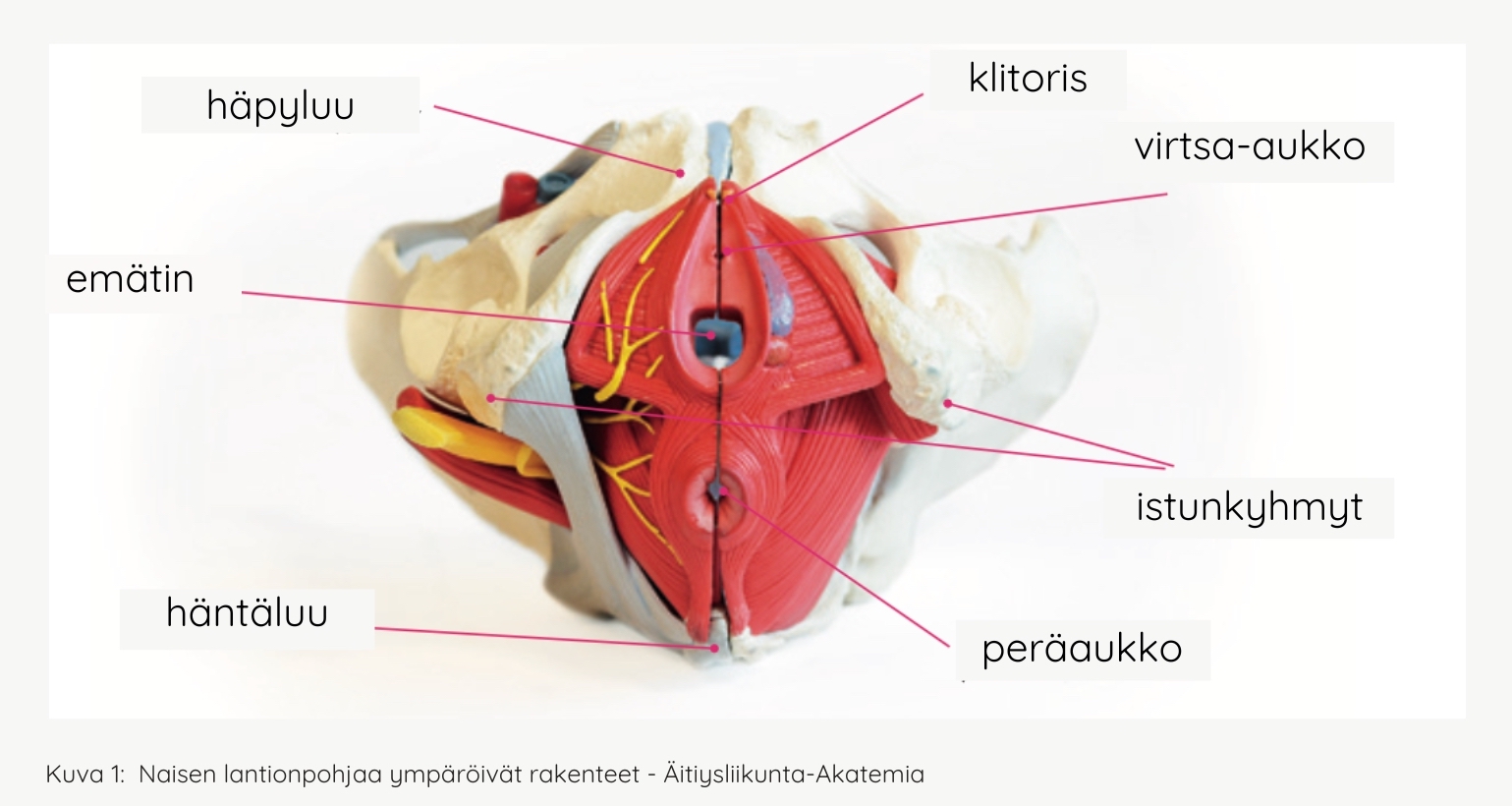
Muscular structures of the pelvic floor and their functions
The pelvic floor muscles are made up of a total of three different layers of muscles, which run between the pubic and tail bones, between the ischial bones and around the orifices. Each muscle layer has its own important functions. The pelvic floor muscles take care of, among other things:
- urinary, gas and faecal retention capacity
- on the prevention of gynaecological plaque formation
- sexual pleasure
- good posture and body support
- deep support for the midsection
- bladder and bowel functions
What if the pelvic floor doesn't work?
Throughout the life cycle, many things affect pelvic floor function and therefore women of very different ages can have pelvic floor symptoms. Stress, strain, bowel problems such as constipation, obesity, pregnancy, childbirth and menopause are examples of things that put strain on the pelvic floor. The most common pelvic floor symptoms include urinary, gas and faecal incontinence, gynaecological deposits and the resulting sensation of pressure, and challenges with urination and defecation. Painful conditions such as intercourse pain and cramps are also indicative of pelvic floor dysfunction, as are challenges with sexual function.
A good and functional pelvic floor provides a strong base for the lower pelvic floor. It can be activated during movement and when pushing, for example, but is also relaxed enough to take the strain. Often we go wrong by only trying to strengthen the pelvic floor muscles, but forget to relax them completely. Tense and even tight pelvic floor muscles can cause very similar symptoms to those of weak muscles. It is also very common to activate the wrong muscles, such as the abdomen, buttocks and thighs, when exercising the pelvic floor. In this case, it is important to take your time and do some identification exercises to make contact with the right place.
Pelvic floor connection to breathing
The pelvic floor muscles do not work alone in the body, but are part of a larger whole. One of the most important skills for both relaxing and strengthening the pelvic floor is to breathe sufficiently downward to restore spontaneous movement to the pelvic floor. In the future, we will share with you an important exercise to get your breathing and pelvic floor muscles working together so that your pelvic floor is active all the time, without separate contractions!
For more information on pelvic floor exercises, we recommend you read the Maternity Academy blog Pelvic floor muscle workout - how and when?


